Wednesday, January 25, 2012

A little update on us.


For those of you who have been following our blog, getting our newsletters or seeing us on facebook you might be wondering where we are and what we’re up to.
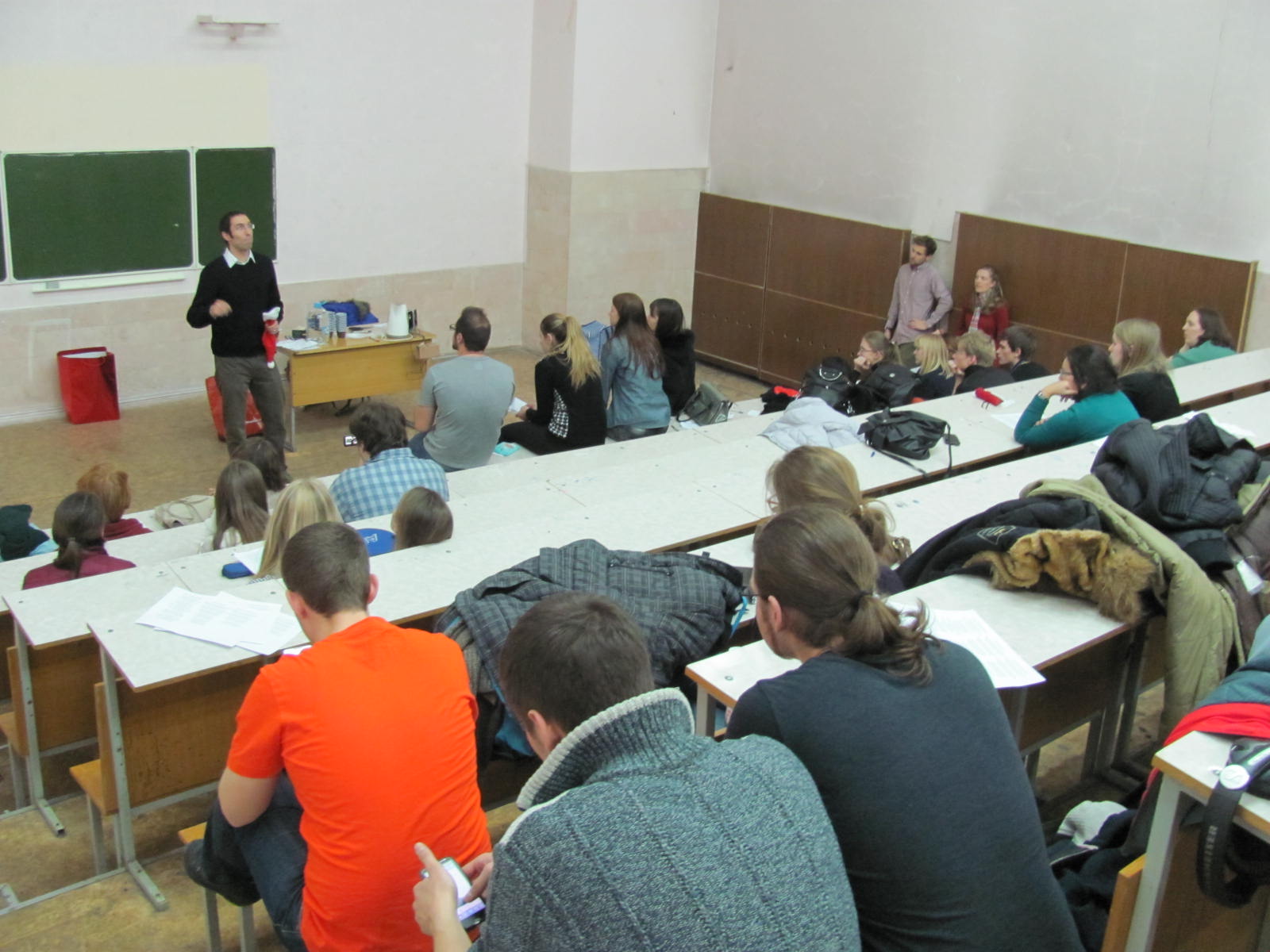
This past fall and winter have been crazy for us with visa trips, a seminary class that we hosted in Moscow, an orphanage trip we planned and then preparations for our first furlough, oh and on top of that we’ve been doing our regular ministry with the students of Moscow. Like I said, a little crazy. The dust is finally settling so I thought I’d give a brief update for those of you who were wondering and wanted to pray for us and hear from us.
We are in San Angelo, TX now and will be here until late April. Our organization gives us two months of furlough (sabbatical and fundraising time) for every year that we are on the field. We’ve been in Russia for two years so we are here for four months plus an extra one for the birth of our first child.
The first month in America was great but also busy. After praying our passports through Immigration Services in Moscow where they extended our 3 month visas into year-long visas (praise the Lord and thank you again!) we got our passports in hand and then jumped on a plane bound for the US 18 hours later. Another close call, but close calls seem to be the norm for us so we’re getting used to it. We made it to the US on Dec 15th, in time to see my youngest brother Andy graduate from CSU. Way to go Andy - we’re proud of you, bro!
 Us goofing off in Steamboat with my family


After that we had some much needed and well-spent time with my (Dave’s) family in Colorado. We celebrated the holidays together and found out on Christmas Day that our little expectant bundle of joy is going to be a boy! What a thrill that was.
After the holidays we flew down to Fort Worth to do some recruiting at the annual Red River Winter Conference. It was a great time for us to reconnect with some of our good friends on Staff with Cru and to see and catch up with the students who have come on previous Summer Projects to Moscow. We were able to join forces with those former S.P students and recruit current students to take a leap of faith and come to Moscow for the summer and maybe for a year on STINT. The recruiting was a lot of fun for us because we were able to cast a vision to the numerous students we talked to and we got to see former students talk about how great of an experience it was for them.
After the conference we stuck around the Dallas/Fort Worth area to reconnect with some of our ministry partners and to do a little fundraising. We were blessed to get to stay with some of our best friends, Jack and Emma Murphy (check out her stunning photography blog http://pherophotographyandpoetry.blogspot.com/) and their amazing little boys: Jackson and Jonah. It was a great week for us and we loved the memories we got to build with them.
Jess 6 months pregnant

After our time in Dallas, Jess and I parted ways for a couple of weeks. Jess went to San Angelo to be with her family and to rest up - the holidays, recruiting and fundraising while 7 months pregnant can be a little exhausting. I went back to Colorado to do some more fundraising and to visit with my family and friends a bit more. One of the small perks of being in Colorado these past two weeks was I got to sneak in a day at Winter Park with my family and experience a great day of skiing. The snow was soft, the sun was bright and my legs remembered how to ski like I was 22 again. The only difference from my early 20’s was that this time at the end of the day I needed a couple bags of ice, some Ibuprofen and a hot tub.  
Now we’re both back in San Angelo and will be here until a month or so after the baby is born. If you’re in West Texas we would love to see you. Shoot us an e-mail or call us. We’ll be in Colorado again in late April/early May and would love to see you if you’re there also.
For now please pray for us as we rest, raise support and prepare for life to completely change. Jess is due in 7 weeks and we’re on our way to a life-changing experience. We’re pretty excited. 

Saturday, December 31, 2011

Trinitarian or Monadic Monotheism


Recently I had the pleasure of visiting Albania for a seminary class that I took through Cru. The premise of the course was fascinating to me and the location of the class was another attractive draw. I’ll break this blog post up into two segments, one will be on the class and the other on the country of Albania. I hope you enjoy them both.  
The Class
The class was about contrasting Trinitarian Monotheism with Monadic (think mono - only one) Monotheism. Most of the world religions that believe in a god believe in Monadic Monotheism. That is to say they believe that God is one and only one and that there is no distinction within God. Islam believes in this as do Jehovah’s Witnesses and Mormons. Christianity is unique in many ways, but notably in its understanding of the nature of God. In Christian theology God is one...in three persons. There is only one God, but he exists eternally in a triune relationship consisting of the Father, Son and Holy Spirit. Each member of the trinity is distinct yet all three are one God. When we contrast the Monadic God with the Triune God the differences are enormous and have major practical consequences in matters of doctrine and practice. 
This is what the class was about and I can’t tell you how enjoyable it was and how much I learned about God as a result. It left me worshiping the Father, Son and Holy Spirit more and marveling in his nature.
The teacher of the course was a godly man whose ultimate aim in the course was to lead us into deeper worship and love of God. The thing that most blew my mind was when he pointed out the logical conclusions of what happens depending on what is believed about the nature of God. If God is only one, he cannot eternally possess the attribute of love. The reason for this is that in order to experience love there must be the lover and the beloved. If there was nothing for God to love before the creation of the world then he does not eternally possess the attribute of love, therefore it is not a character trait of God. Thus, a Monadic God is not a loving God. 
On the other hand if God is eternally triune, as Christians believe, then one could argue that he was in a relationship with himself before the creation of the world. That relationship is marked by a self-giving, concern-for-the-good-of-the-other love which overflows into the creation of the world. Because God has always expressed, received, given and observed love from before the creation of the world it can be said that a Triune God really is loving. 
The consequences of this are amazing. If love is not an attribute of God, merely an action he sometimes uses then his love is arbitrary and unreliable. Likewise if mercy, goodness, justice and wrath are actions or characteristics he sometimes employs then they are not always employed by him and he cannot therefore be described as merciful, good, just or wrathful. 
Yet if he possesses these characteristics or the potential for them as attributes since the foundation of the world then he can be described as merciful, good, just, wrathful and so on. The result is either a God whose will is capricious and arbitrary or a God whose will is based on his nature and is reliable and trustworthy even if it doesn’t seem that way.*
*(I recognize there are some flaws in this logic and I’m doing my best to paraphrase the ideas taught in class, if you’d like to help me refine this reasoning I’d love your feedback.)

Albania


This is part two of a two part update on a recent trip I took to Albania. Here I talk about how great Albania and Albanians are.

The Country of Albania
The class was amazing and I learned a ton about God, Islam and Christianity, but what I enjoyed the most was the staff I got to meet in Albania and the city of Tirana. For years I had heard about the great things that are happening with the Church in Albania and I’ve always wanted to go and see it for myself. Now I finally had a chance to shake the hands of some incredible saints and hear their stories.
Let me give you some context first. Albania is a tiny country that was under control of the Communists for several decades. It completely outlawed religion of any kind even though it produced one of the greatest saints of the 20th century, Mother Teresa. Today it is religiously tolerant with Muslims making up the largest percent, followed by Catholics and then Protestants bring up with the rear with a tiny percent of the country describing themselves as Evangelical. Even though it is a majority Muslim country most of them are secular. 
As soon as I left the airport I was struck by how warm it was. I flew in from Moscow at the end of October equipped with a down vest and a ski jacket to keep me warm. When I arrived I had to take both off and walk around in my shirtsleeves because it was a warm 70ºF. I loved it! Then I noticed the people. Afrim, the staff member who picked me up from the airport said that Albanians are known for being really friendly. He had studied at Dallas Theological Seminary for a couple of years and knew how friendly Texans were. He said that he thought Albanians were sort of like the Texans of Europe, really friendly, really hospitable and would go out of their way to help a guest. That made me chuckle, but it really was true. I was constantly surprised by how friendly everyone was. From taxi drivers, to vendors to the staff we met and hung out with during our classes everyone was eager to please and easy to talk to.
I had the privilege of getting coffee with the Campus Director of Tirana. He was my age, about my height and of similar temperament. As we talked I realized that he easily could have been a good friend from a summer project or a buddy of mine from my college days. Even though we grew up in very different cultures and had different life experiences he wasn’t all that different from me. This has been of the most surprising reoccurring discoveries for me as we live and work overseas: people really aren’t that different from each other no matter where they are from or how they grew up. Yes, there are cultural differences and differing values and stronger characteristics in some cultures than in others, but largely we are the same and want the same things, dream the same dreams and need the same savior. These were some of the things my friend Gusti (short for Augustine) and I talked about over coffee one warm Tirana afternoon.
We also talked about where they could go as a ministry. Currently they have about 130 students coming to their weekly meeting. 130 students! I don’t think I’ve met 130 Christian students in the four years we’ve worked in Russia. I couldn’t believe it. Then he asked me what I thought they should do next and how to expand. I didn’t know how to respond, I haven’t seen that many students at a weekly meeting since I visited CU - Boulder in the early 2000s. I told him about what we were trying to do in Moscow. Basically we let the students run everything and we coach and train the main leaders so that they can be more effective. We push leadership down to the lowest levels so that everyone can buy in someway or another and train the leaders in a way that they can turn around and train others. At least that’s the idea, we haven’t gotten really far with it yet. But, that’s why we pray and work hard and trust God for the rest. I hope that God gives Gusti and his team a unique vision as to how to expand their ministry and influence and train others to be disciplers of others. Whatever happens, we know that God is good in all of it, because that’s his nature.
There are a couple other things worth mentioning. The food there was really good and affordable. I think I put on five pounds in the eight days I was there. The staff who have been there from near the beginning are some the heroes of the faith to me. They’ve dealt with some frustrating and difficult circumstances but have also seen God do some amazing things. They have done a great job of being responsible and visionary with the talents and fruit that God has given them. I pray that the same would be true of us as the staff in Moscow and in Russia. 
All in all my trip to Tirana was great. The teaching, the people and the experiences there were fantastic and I’m so glad I had the opportunity to go and see what God is up to there and learn more about him in the process. If you have the chance to visit Tirana I suggest you do it. It’s not at all like the rest of Europe, but it is worth the trip. Also if you want to read more about the differences and similarities between the Christian and Muslim God I suggest reading “Is the Father of Jesus the God of Muhammed” by Timothy George. Another one worth reading, but reading closely and critically is “Allah: A Christian Response” by Miroslav Volf. Lastly read Ida Glaser’s article. 

Saturday, November 12, 2011

The Three Musketeers 3D - 'meh


3 Musketeers
Recently I watched the latest rendition of the 3 Musketeers. There have been many re-imaginings of this in Hollywood throughout the years. Some good, some not so good. This one was creatively titled “3 Musketeers 3D”. It was exactly what it was made to be: a big-budget, easily retold story that could be done in 3D. That’s what I appreciated about it; it didn’t try to be anything more than it was. It was playful with lots of sword fighting, 3D effects, intrigue, some laughs and a love story.


That being said, it wasn’t very good. The dialogue was forced, several parts of the story were beyond unrealistic and even distracting in how far-fetched they were, and the entire time I kept comparing it to the 3 Musketeers filmed in the 90s with Keifer Sutherland as Athos, Charlie Sheen as Aramis, that other guy as Porthos and Chris O’Donnell as D’artagnon and Rebecca de Morney as Milady. That rendition - the 1993 one - was good, not a masterpiece of action/adventure filmmaking, but still a memorable and fun movie. This movie - 3 Musketeers 3D - left me with a smug smirk as if watching a cover band use fireworks to distract the audience from it’s obvious lack of talent. 

Any remake of a film shouldn’t bring us back to the previous rendition of the film and force us to compare scenes, dialogue or storyline. Yet, I couldn’t help but measure each memorable scene in this movie to the previous rendition feeling like they didn’t get it right.
I wasn’t expecting much going in to it and that’s what I got.
See this if:
-you want to not think for a little while
-you want to be entertained by lots of special effects in 3D and have nothing else to do
-you liked any of the Transformers movies (it’s basically the same movie with guys in funny hats and swords rather than alien cars shooting at each other)
-you want to see Orlando Bloom make a fool of himself in what might be his worst role or performance ever (he’s one of the bad guys)
Don’t see this if:
-you’re looking for a good telling of the Alexandre Dumas classic (wait another ten years for the next one to come out, it might be better, but it might not) 
-bad dialogue drives you nuts
-you despise the idea of the French winning anything besides a cooking contest

Saturday, November 5, 2011

Spending a Day with the Lord

One of my favorite perks of working with Cru is that once a month our staff are encouraged to take a day to really connect with the Lord and “do business” with him. This day can look different depending on what our needs are at the time or how we sense the Lord is leading us. Usually I’ll find a corner in a coffee shop and journal, pray and read Isaiah or one of Paul’s letters. There’s something about those books of the Bible that really remind me of how grand the Lord is and it puts everything back into perspective for me.

I’ve not been as disciplined in taking these “Days with the Lord” as I would have liked this past year. So I decided that this time I would really focus on it and make sure to clear time to really enjoy the Lord and create space for him to work.

So I went to McDonalds.

That might not seem like the most ideal place to go to meet with the Living God, but McDonald’ses(?) are ubiquitous here in Moscow and you can usually find an affordable cup of coffee ($2 compared to the $8 at Starbucks) and a place to sit unperturbedly for a while. I found a table on the second floor with a view and sat down with my journal and Bible. That’s when the homely cleaning lady decided it was too peaceful and quiet for 10 am on a Monday and she cranked up the Ke$ha on the overhead speakers. I tried to make my mp3 player overpower the obnoxious monosyllabic squeals on the radio by having Charlie Parker and his soothing saxophonic rhythms soothe away the musical pain. But alas, it was all in vain. Admitting defeat I packed up my things and headed into the welcomed chill of the Moscow Morning.

Realizing that I was at Tretyakovksaya metro station and that the Tretyakov Art Gallery was just around the corner I thought that this would be a wonderful way to spend my day with the Lord. Some jazz music, some fine art, a journal and a Bible; I would finally be able to use my education in the humanities! So I quickly turned right, crossed the street and in step with Charlie Parker’s drummer I headed toward the museum. That’s when I got to the front gate and realized it was a Monday…in Russia…and Europe…where museums are closed on Mondays. Bummer. Now it was time to come up with plan C.

I perused my iPod and noticed that I had some sermons that I hadn’t yet listened to. I found one that caught my eye and began listening and walking.

Downtown Moscow is a great city for walking. There are hidden parks tucked away in between busy four-lane roads and bridges with great views as well as plenty of benches to sit and rest on. After wandering and listening to the sermon I decided to walk along the river and take in the view. I began listening to Chris Tomlin’s “Arriving” and sang along.

Suddenly I was behind the “New Tretyakov Gallery” and noticed that there was a massive art sale lining the river. Art dealers from all over the world and Russia had come to sell their work for a week and today was the last day. It being 11 am and a Monday I was one of the only people there. With Chris Tomlin leading me in worship I found myself taking in paintings of landscapes, portraits, abstracts and still-lifes. It wasn’t a world-class art gallery, but it was still beautiful.

As Chris Tomlin belted out “Indescribable” I noticed a landscape painting of a forest with a winding path. The leaves were green and yellow, the light soft and warm and the path leading somewhere unseen off to the right. I looked closer and saw that not all, but many individual blades of grass were illuminated by the rays of light streaming through the leaves of the birch trees. A verse from a David Crowder song came to mind and I sang quietly “every ocean, every sea, every river, every stream, every mountain, every tree, every blade of grass will siiiiing…make a joyful noise to the Lord all the Earth.” All at once I was wrapped up in what felt like a hug from God. A smile, broad and toothy, spread across my face as I closed my eyes and savored the moment.

“You are one of those blades of grass, and I am illuminating you.”

That was all I could hear though it was inaudible. The moment lasted for a second or two and then it was gone. That was ok with me, it’s been a long time since I’ve sensed God’s nearness and adoration in such a powerful way and I was grateful for the moment.

As I continued on through the art collections I noticed paintings of Moscow that looked sort of like Moscow but something was off. I would look at a scene of the river or of a famous street brightly colored, clean and ideal, then I would turn around and see Moscow as it really was. It was busy, grey, and drab, almost like a zombie: not dead, but not fully alive either. I turned back to the brightly colored, idyllic paintings and wondered why there was such a contrast between what was painted and what really was. Why would someone take something that is real and repaint it in a way that wasn’t real, but was better?

It struck me that that is what much of what art, literature and music is. It’s an expression of what should be rather than what it is. It’s a retelling of something that is better than what we can currently see, hear, taste, smell or feel. I have no idea what the worldview of the artist was who painted that Moscow street scene, but what his art was inadvertently saying when contrasted to the current reality is that something can be more beautiful than it currently is. This made me wonder why it is nearly universal that we as humans know that things can, and often should be better than they are. Is it because we’re naturally gifted at seeing what’s wrong with things? Or is it because we were born for a place where things really are better?

As C.S. Lewis said “These things [beauty, nostalgia] are good images of what we really desire; but if they are mistaken for the thing itself they turn into dumb idols, breaking the hearts of the worshippers. For they are not the thing itself; they are only the scent of a flower we have not found, the echo of a tune we have not heard, news from a country we have never yet visited.”

The idyllic images displayed haphazardly on the embankment that afternoon were a reminder to me that God has asked us to tell his story with the talents he has given us. For the artists, whether they knew it or not, they were telling the story of the once perfect and one-day-to-be-redeemed world. The musician creates harmony out of chaos; the writer retells a story that is at once his own and begotten from another time; the painter expresses an understanding of beauty beyond herself.

The ideal great city, struggling to be expressed in that Moscow street scene, will exist on the other side of Heaven. In the meantime he has us here in the not-so-ideal, the fallen city in order to tell others and remind each other about the one who will redeem it and his (and our) incredible story.

That day spent with the Lord was a valuable reminder to me of the truth that God is active in all kinds of ways and that his attributes and character can be known, felt, understood and retold even if the teller does not personally know him. Solomon said that God has written eternity on the hearts of men and Paul echoed that by saying that what can be known about God is plain to all people, because God has shown it to them. When we read literature, or look at art or enjoy music or even watch a story told in a sitcom or through a documentary are we doing so simply hedonistically - for our own pleasure - or is something in our soul crying out to connect with the Great Artist and his great story?

Monday, September 19, 2011

Book Review: The Fields of the Fatherless by C. Thomas Davis


God makes it abundantly clear in the Bible that he cares deeply for the alien, the orphan and the widow. His love and zeal for the justice of those that live on the margins of society resonates throughout both the Old and the New Testament. 
Unfortunately, many Christians today don’t look at the margins of society. The marginalized don’t go to their churches, they don’t work with them or play little league with their kids. To many Christians the least of these are unseen and unnoticed. Sure, when asked many Christians will say they are concerned for the poor and want them to be helped, but they just don’t know how they themselves can help. 
This is the connection that Tom Davis seeks to make in his book The Fields of the Fatherless: Discover the Joy of Compassionate Living. Far from a scathing critique on the lack of social action in the church today Davis’ book is more a gentle introduction between one person who can help and another who needs it. 
Davis begins by comparing concern for the poor (a.k.a. social justice) to discovering a hidden treasure that was right under your nose. He tells the reader to imagine that the book is “a treasure map that unlocks a marvelous treasure chest of truth about what matters most to God - and should matter most to us.”
He begins with showing the biblical mandates to care for the alien, the orphan and the widow and the Old Testament promise of blessing (not necessarily material blessing) that comes from it. He then shows us real life stories of the fatherless today. They are the single-mother next door working her hardest to make ends meet, the widow/widower at church who just lost her/his spouse of 40 years, the unruly boy in your child’s class who gets passed from one foster home to the next, the orphan in the orphanages around the world, the migrant worker looking for work at Home Depot or the lonely foreign exchange student looking for a taste of home. The fields of the fatherless are all around us, we just don’t know they are there.
Davis then gives some practical steps we can all take to reach out to the least of these that are in need of help. Steps like volunteering to be a foster parent, helping out at a soup kitchen, running errands for a single-mom or writing letters to orphans. He recommends a few ministries to get in touch with as a means of practicality. The rest of the book is filled in with principles for serving the poor and personal stories of heartache and hope to educate and inspire.
The writing style wasn’t superb and I was curious about the basis for some of his finer points about God’s promised blessings (I’ve been reading a lot of Larry Crabb recently so that might have influenced it). The book left me wanting for more; whether it was a simple challenge to do this, this and this or a notion that what he is positing is achievable.
Overall I would say it is worth the read. It’s not an exhaustive approach to social justice or a manifesto on how to save the world as Christians, nor is it about proper ethical positions toward the poor. It is a focused and compassionate appeal to Christians to look up and see that there is a harvest field of orphans waiting to be cared for and loved by those whom God has spiritually adopted himself. I was inspired by it and thought constantly throughout the book about what I could do and was encouraged and challenged towards the end to remember that I was spiritually an orphan and yet God took me in and loved me even though I seemed unloveable at first.
Recommendation: Read it.

Monday, July 18, 2011

A Better Hope for a Serious Man

One of the marks of a good movie is that days after seeing it questions about it remain with me. I’ll be doing the dishes and just as suddenly as that microwaved cheese stuck to my plate is scraped away the mental pathway of artistic clarity opens up and an epiphany will strike me. Or I’ll be in the shower washing what remains of my once full head of hair and I’ll ask under my breath “is that what that scene meant?”


Recently I watched a Coen brothers film entitled “A Serious Man”. When it was over my friend and wife and I contemplated its meaning and were lost for words, there seemed to be no real meaning to the film. I asked the world of facebook for its thoughts and heard nothing except for a lone, distant “like”.


The movie is set in the 1960s in suburban Minnesota. The Protagonist, Larry Gopnik, is a Jewish physics professor who suddenly sees his world imploding around him. Every relationship in his life is suddenly and suffocatingly strained. One thing after the other begins to crumble and his life is seemingly headed toward ruins. In a panic he goes to the local Rabbis and his lawyer for counsel. He talks to one and then the other but their counsel is more confusing and depressing than helpful.


As the story unfolds and the hope of redemption slims he asks angrily “Why is this happening? I have tried my whole life to be a serious man. I am a serious man, why is God doing this to me?” I won’t give away the denouement, but I will say that the directors do an excellent job of asking the question “why do bad things happen to good, or at least decent, people?” However, in typical Coen brothers fashion they don’t give an answer, just a mischievous wink.
A few weeks later I was reading through the book of Job. As I was reading it my mind flashed back to various scenes of “A Serious Man”. When I read about Job sitting in sackcloth and ashes bewailing his situation while his misguided but concerned friends looked on I saw the scene where the man who is trying to steal Larry’s wife is also trying to comfort him. Then I read about Job defending himself and saying “I haven’t done anything wrong, if I had then let punishment come, but I haven’t, I promise.” That’s when I saw Larry proclaiming he is a serious man to his Rabbi. Yet again, Job laments that God is not even hearing his complaints, he is castaway, floating in an ocean of accusation with no accuser to confront him. I read this and I saw Larry practically pulling his hair out yelling “How can he ask us to field these questions if he doesn’t give us any answers?!”
In the book of Job and the film both characters ask why bad has befallen them if they have done nothing wrong. They both believe that there is an unspoken contract with God that if they do A then God gives them B. If I am moral then I live a comfortable life. If I’m good to my family then I will have a happy family. If I follow your rules, God, you are obliged to provide for me as I wish. This is the law in linearity...and it leads only to disappointment.
I’ve also been reading the thoughts of a different Larry. Larry Crabb. The ideas in his book “The Pressure’s Off” have begun to resonate more clearly with the images of the film in my mind and the sympathetic emotions I feel for Job in my heart. The thesis of Crabb’s book is that we think that God operates on the law of linearity, but this not so, God is calling us not to a better life, but to a better hope.

Crabb points to the new covenant proclaimed by Christ. It used to be that as long as God’s people obeyed his commands (the Law) then he would bless them. As New Testament readers we understand now that the Law was put in place to show that none of us could ever live up to its standards, we would always fall short. Therefore, when Jesus came, lived life perfectly under the law, then was sacrificed on behalf of a people who could not live perfectly under that law, he ushered in a new era, an era that points to a better hope, rather than a better life. Hebrews 7:18-19 tells us that “On the one hand, a former commandment is set aside because of its weakness and uselessness (for the law made nothing perfect); but on the other hand, a better hope is introduced, through which we draw near to God.”
God is saying he is not as concerned with us being happy as he is with us knowing him. Yes, he wants to give us good gifts - he is a good father after all - but the greatest gift he gives is himself, and that is the better hope.
Job complained because the law of linearity states that he lived well, gave generously and was a good father and husband, therefore he deserved a good life.

Larry Gopnik complained because the law of linearity (and as a physics professor he knows that laws are logical and cannot be contradicted) states that by all accounts he is a serious man and should not be suffering the way he is.

I complain because I try to be a good man but things often don’t go my way and my life is not the one of bliss, triumph and far-reaching effective ministry I believed it would be when I signed up for ministry. I’ve done all the training, completed all the steps, did what needed to be done yet I’m still unsatisfied and restless.

Why? Is it because I, like Job and Larry Gopnik, believe that God owes me? Is it because maybe I love God for his stuff rather than for himself? Is it because I’m like the prodigal son and want my father’s inheritance more than I want my father’s presence?
The promise of a better hope is something that is missed in “A Serious Man”. The ending is unclear as to whether it is a comedy or tragedy, and God remains a mysterious, unknowably powerful force. He is that indeed, but he is nearer than he is farther and this truth is hidden in the book of Job. At the end of Job’s lament, after God asks him where he was when the world was made Job realizes his place before the Lord. God responds to him, not with an answer, but with his presence, and that is enough for him.
I wonder what this new way of living would look like for Larry Gopnik. I wonder what it looks like for me.

p.s. I recommend both Larry Crabb's book and the Coen brothers' movie, though parents be warned this isn't a movie to show the kids, it's rated R for a reason.